
PhD Journey #1: Starting third year of my PhD journey into trauma education
Includes a reflection model I am using to reflect along the way

Hello friend, I am so glad you are here…
I wanted to use this space to track my experiences as a graduate researcher in the final year. Each entry will become a small act of noticing, wondering, what sparked my interest, what challenged my assumptions, what ideas stayed with me long after I closed the book or stepped away from the work. Here I am returning to the page regularly, I practice my attention, deepen my reflexivity, and create a traceable map of my intellectual and creative process.
There is a lesson in everything, I believe. Some lessons are going to be light, funny and others will be deep and heavy.
My research is in teaching and learning trauma-related content so there will be at times some sensitive material explored. With those post, please be gentle with yourself. Skip what you don’t need to read or want to know about.
Please take your time in digesting, self-loving and pausing when you need a mini retreat.
PhD Journey
I have learned overtime that reading and writing are two halves of the same creative practice one fills, the other releases. My PhD life is all about absorbing readings, reflecting on what I am reading and then transforming it into written text, in my case a thesis and academic textbooks (if you are curious my work can be found here Tutorial Ideas for Educators on the Run).
When we read, we absorb ideas, stories, words, structures, questions, and possibilities that quietly shape how we think on the page. Stories teach us how experiences are expressed; arguments teach us how ideas hold together; even a single striking sentence can change the way we understand that experience. Over time, this back‑and‑forth becomes a kind of learning, lifelong learning as reading expands our inner library, and writing transforms that influence into something distinctly our own.
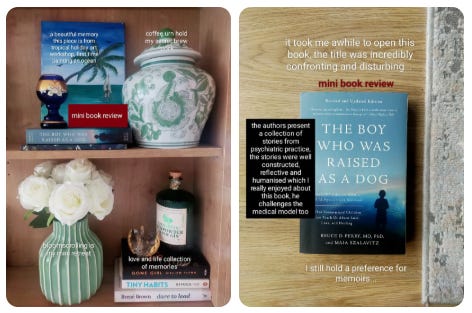
Photos from of my week, sharing what I am consuming and creating.
My PhD weeks fill with readings and writing, comparing new ideas with old ideas. There is quite layering that begins to happen where new ideas brush up against old ones, reshaping them, softening them, or sometimes sharpening their edges. Each word that I encounter becomes part of an ongoing conversation, and my writing becomes the place where that conversation settles into clarity. Over time, this pulse starts to beat stronger in the wind of taking in and putting out intellectually rich hive with fragments of breaking down, recombining and nourishing whatever I am working toward next.
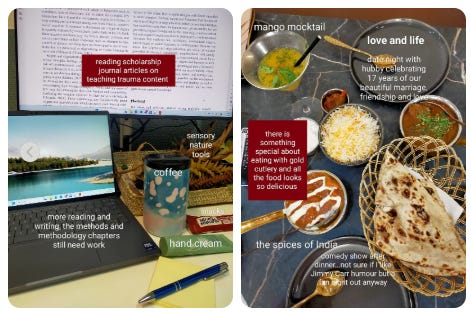
Photos from my week, sharing how I release what I consume and create.
I’ve learned throughout my PhD journey that when I release my thoughts onto the page, something inside me loosens too. Letting the work take shape in text feels like giving my mind permission to rewire itself a small act of neuroplasticity in action. Happening while I work. Each sentence becomes a pathway, each reflection a gentle rerouting of old pathways into new possibilities. New ambition. Writing becomes less about getting it “right” and more about allowing my inner hive move, learn and grow in ways it couldn’t if I kept everything contained inside.
Time to pause and take a mini retreat.
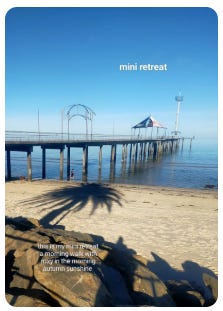
This photo is a reminder I need to bring mini retreats into my days.
The Idol
There are many researchers that have I have admired over the few years, but Brene Browns work not only inspires me it moves me, I fell in love with her methodology and approach to research. I first learned about grounded theory through her work and that’s when I started considering it as an approach before I started my PhD.
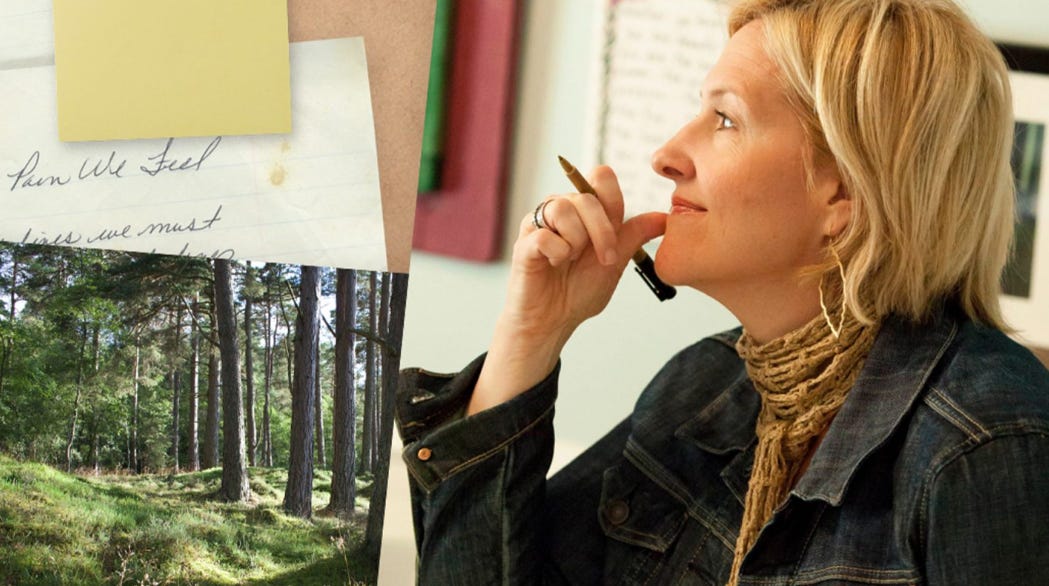
Reflection Model
I am using this simple model of reflection to help me understand my process, what works, what does work and where to invest my energy next. This is a tool I would teaching social work students and I would use in practice to guide my reflection and continue learning.
The model was developed by Rolfe et. al. (2021) to deepens the process of understanding and move into reflexivity like a researcher. Its: What? So what? Now what?
Firsts ask about, What? What readings did you find, save and decided are worth keeping? What is the theme?
Second, ask yourself, So what? Write the moment when you were reading. hat changed in your thinking? So, what, why did it matter to you?
Thirdly, ask yourself, Now what? How do these readings align or not align with your personal experience?
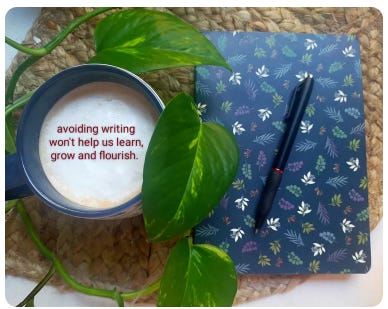
One of my research diaries where I document my thoughts, ideas and reflections.
Continue reading…

There were so many parts I wanted to highlight!
“When we read, we absorb ideas, stories, words, structures, questions, and possibilities that quietly shape how we think on the page. Stories teach us how experiences are expressed; arguments teach us how ideas hold together; even a single striking sentence can change the way we understand that experience. Over time, this back‑and‑forth becomes a kind of learning, lifelong learning as reading expands our inner library, and writing transforms that influence into something distinctly our own.” This is well said. I can resonate with every word.
Second, the “What, So What, Now What?” I’m not sure if this was your intention but it’s a wonderful way to ask yourself how you’re digesting the information you’re taking in.
Third, the information about journaling and how much we can get out of it by including both emotional expression and cognitive processing. Fascinating. I was tasked with journaling to help me with my mental health and in having attempted two different ways of journaling, I can easily see the truth in what you’ve stated.
This is so thoughtful and intentional. I love the reflective prompts, especially the “What? So what? Now what?” approach, it really supports deeper thinking. Appreciate you sharing this.💛