
Humming the power of inner thoughts
Hive vibe version of exploring the power of inner thoughts and curious questioning leads to understanding the power of critical thinking.

Dear Beezee Bees
I have been thinking about all my loves lately, one love is, settling into a quiet corner with a book or an idea that invites me to slow down and stretch my mind. Reading gives me a kind of spaciousness an inner clearing where thoughts can wander, collide, and rearrange themselves into something new. In that space, I let myself wonder freely, following questions wherever they lead without rushing to tidy them up or pin them down. Open curiosity feels like a gentle widening of my inner world, a way of noticing what I didn’t see before and challenging what I assumed I already knew. Each page, each pause, each small spark of inquiry becomes a way of expanding my understanding of myself and the world around me, one thoughtful breath at a time shapes my personal curriculum in love and life.

Life in the hive is rarely a straight flight path. Most of us live a life full of lessons of hovering, adjusting, recalibrating our wings as the world moves beneath us. Even the most devoted worker bee knows that existence is a blend of purpose, duty and rest. Each morning begins with the familiar hum of responsibility: attending to the Queen’s grand vision, contributing to the collective rhythm, and trying to keep pace with the ever‑expanding to‑do list that shapes our weekly personal curriculum.
In the Hive, learning becomes both nourishment and necessity. Mindful bees pause to learn about new flowers, changing seasons, or better ways to strengthen the hive’s future. Knowledge is pollen: gathered slowly, carried carefully, and shared generously. Yet the pursuit of learning often competes with the weight of daily obligations and juggling life’s demands. How does one expand their mind while also worrying about whether there will be enough nectar to make it through the week?
Your wings may be tired, but they are strong. Your path may be uncertain, but it is yours to shape. You carry more resilience, more wisdom, and more quiet power than you realize.
Relationships and family weave through this tension like delicate comb. Bonds hold the hive together, but they also require tending moments of connection, repair, and mutual care. Meanwhile, financial worries buzz constantly in the background: Will the honey stores last? Will the next bloom be enough? Housing, too, is never guaranteed. A hive can be shaken by storms, predators, or simple bad luck, leaving its residents scrambling to rebuild.
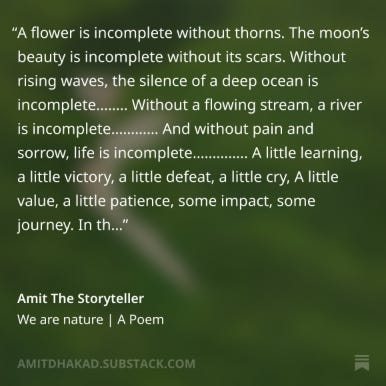
Food insecurity is a quiet ache that many bees carry. A poor season, a lost meadow, a drought any of these can tip the balance from thriving to barely surviving. And all of this unfolds within the rigid yet fragile social structures that shape hive life: hierarchies, roles, expectations, and the unspoken pressure to keep flying even when wings are tired. I found a beautiful poem that recognises nature at work and connects us to it ‘We are nature' by Amit The Storyteller, to me this poem captures the importance of connection between natures elements, like a bee that creates honey.
The Nervous System Buzz
Life in the hive has a rhythm of daily tasks that combines rest, work and play. It influences the deep imprint on each individual bee’s inner hive (aka the body). The constant juggling of duties, time schedules and expectations through a bee’s tiny but powerful nervous system. Even the most resilient worker feels the strain when the demands of the Queen’s grand vision collide with the realities of scarce nectar, unstable hive (aka housing security), or unpredictable seasons. There are a range of psychological perspectives help us understand what is happening inside us, why is it uncomfortable, icky or buzzing.
A bee’s nervous system is exquisitely tuned into sensing danger, opportunity, and subtle changes in the hive’s ecosystem. When food is scarce or the hive’s structure feels uncertain, stress intensifies. Wings beat faster. Decision‑making narrows. The bee becomes hyper‑vigilant, scanning for threats while still trying to gather pollen, nurture relationships, and keep learning. Living in the in‑between means living with a nervous system that is always slightly on edge never fully resting, never fully safe.
Study and self‑improvement, though nourishing, can also add pressure. The desire to grow competes with the body’s instinct to conserve energy. Relationships, too, become more fragile under strain. A stressed bee may withdraw, misread signals, or lose the capacity for the small gestures of care that keep the hive emotionally intact.
Financial and housing worries ripple through the hive like a low‑frequency hum. When honey stores dip or the comb becomes unstable, every bee feels it in their thorax a tightening, a subtle tremor. Food insecurity amplifies this tension, pushing the nervous system into survival mode. And within the hive’s rigid social structures, bees often suppress their own needs to maintain harmony, further taxing their internal balance.
Yet even under this weight, bees continue to hum, adapt, and reach for the next bloom. Their nervous systems, though strained, remain astonishingly resilient proof that life is not just about surviving, its resting and continually redirecting towards hope. Ecosystems have multiple layers and areas of chaos and uncertainty that is embodied.
Spaces of Thinking and Curious Questioning
Creating safe spaces and moments for thinking and curious questioning why things are the way they are becomes a quiet superpower in the hive an inner hum that helps each bee make sense of the swirl of duties, pressures, and emotions that define life in the in‑between. When a bee pauses to question its own experience Why am I flying this path? What assumptions am I carrying? What stories am I telling myself about my worth or my role? Its perspective widens. The hive stops feeling like a rigid structure and starts looking more like a living ecosystem shaped by countless individual choices.
This reflective pause softens the nervous system, too. Instead of reacting automatically to stress signals scarce nectar, unstable housing, shifting hive expectations a bee can step back and notice the patterns, not just within but all around them (aka structures). It creates a gentle invitation to step outside of the hive learn about the world around them. That noticing creates space. Space to breathe. Space to choose. Space to question. Space to imagine alternatives. A bee who questions its own experience becomes less trapped by the hive’s inherited rhythms and more attuned to its own inner self. there are two types of questioning I wish to gently hum about today one uses:
Deficit questioning: “She can’t handle this busy work anymore, she is overwhelmed by hives tasks, overthinking, failing at everything she does, she is burned out and it is all her fault because she is a tiny bee and not resilient enough.”
Strength based questioning: “She has been carrying a heavy load, for a long time today, with little break between collecting pollen, her exhaustion is a sign she needs space to rest. She is self-aware and she is good at her job, she is taking steps to re-energise, she knows I am here to support her when she needs it”.
Thinking critically about our own inner hum also strengthens the hive as a whole. When individual bees examine their roles, challenge outdated norms, or propose new ways of gathering, learning, or supporting one another, the entire colony becomes more adaptive. Curiosity becomes a form of collective strength, and the realisation is that humans need bees more than bees need humans. Questioning becomes a way of attending to the hive’s physical, environmental, structure and social wellbeing (aka the ecological system).
A simple model developed by Rolfe et. al. (2021) to scaffold the critical thinking process: What? So what? Now what?
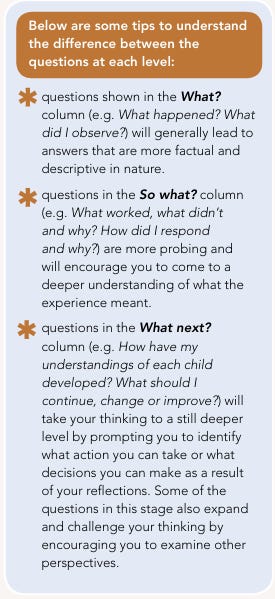
Source: Critical Reflection in Practice Guide
On a closing studio note, this thinking and curious questioning is a practice helps each bee understand that its life is not just about serving the Queen or surviving the next season. It is about meaning making. It is about discovering how one small wingbeat contributes to the larger hum. It is about recognising there is room to grow, to question, and to redefine what we see and believe to be true.
Strength isn’t the absence of obstacles and limits. It’s the capacity to keep humming anyway after rest and reset.
Every bee every person holds this power. The power to influence the future with a single thoughtful action. The power to soften the hive’s edges through strength-based thinking and questioning. The power to reshape old patterns with curious questions. The power to rise, again and again, even when the world feels heavy.
Keep flying. The hive hums because of you!


You're really smart to use this metaphor. It SO works!!
this whole bee metaphor is way too good. like… why is this making me reflect on my entire life.