

Longing for a quieter life in the hive
It is the heaviness of the world that just keeps on buzzing when my body is longing for a pause, a rest and gentle attention.

Hello Beezee Bees,
Some days, my inner hive feels like it’s working overtime. Not in that sweet, purposeful way where every idea has its own little cell to land in, but in that oh no, everyone’s flying at once way. Wings brushing wings, voices colliding mid‑air, and pollen spilling everywhere causing collisions and crashes that are just too painful to bear. A whole internal traffic jam of good intentions. It usually starts quietly one tiny worker thought zipping past with a reminder, then another with a worry, then a third with a “hey, don’t forget this!” Before I know it, the whole colony is swarming, and I’m standing in the middle of it all, trying to hold a clipboard that keeps slipping out of my hands.
Is this a familiar feeling?
In those moments, I don’t feel like the queen of my hive. I feel like the overwhelmed beekeeper who forgot her gloves and her endless number of jobs on her to-do list for the day.
Then something soft happens. One gentle bee the same special one lands on our shoulder. I tense up, feel the tension in my back and neck, droplets of nervous beads are forming on my forehead. My thoughts spiral ‘what did I miss’ and ‘have I done something wrong’ and revise my to-do list in my head.
The bee doesn’t buzz instructions or add to the chaos of my ever-ending to-do list. She just rests there and lowers her gaze, ‘I am so tired’ she whispers, ‘it is time to rest’ she says, softly, wisely, calmly.
So, I breathe.
I draw my focus on my breath and notice how cool it feels. I close my eyes and notice the warmth on my face and feel grateful for that moment. I notice the hive doesn’t stop being full and the buzzing noise fades, quietens and softens. It just becomes held again. Contained. Within.
And in that quiet moment, I remember feeling overwhelm does not represent failure. It is the heaviness of the world that just keeps on buzzing when our body is longing for a pause and a rest. I turn the focus on me, show myself some kindness and sit with the buzz until it softens.

The Experience
This is my cognitive overload. It is my state of overwhelm and to be completely honest I have 354 unfiled research articles stored in my cloud that I need to sort through and file in my friend Endnote research manager.
I have a few more transcripts I need to analyse to add to my research story - this brings me so much joy, and time and care needs to be scheduled into this important work.
I started with this pile in my creative space right before I started writing on Substack and slowly converting my notes and scribbles into articles - it still feels like a chaotic mess with 15 draft copies of articles to refine, re-write and beautify for my beezee bees. I have taken a photo and exposed my imperfect self which makes me feel exposed and accountable to me now. My quiet comfort is that I know I am in good company with my readers.
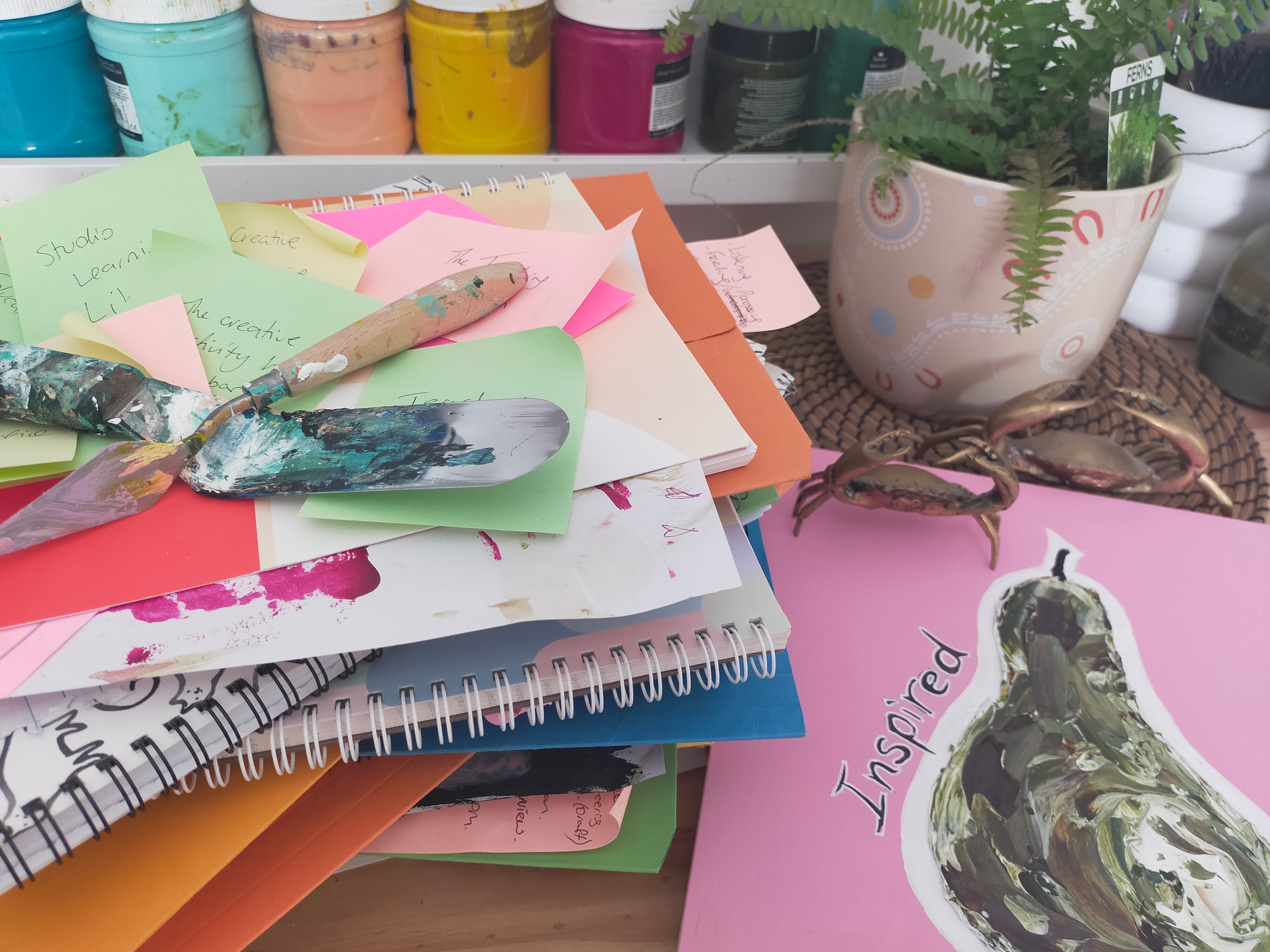
Image: A pile of work in my art studio (and the unfinished commission painting that is quietly waiting) In this picture are notes, ideas, doodling, thoughts, wonderings, post it notes, references and research articles. I need to create space and time for sorting in a meaningful, manageable and quiet creative way so I can feel like me.
How did I get here?
I wondered too… so I read a few research studies to help me answer this very question, reading research gives me quiet comfort. I see research as a collection of variety of shared experiences and different perspectives of lots of individuals across culture, gender and societies that have been analysed and summarised for our benefit. Translating the research also takes time in reading, care in thinking, curiosity in reading more, practice in noting taking, and questioning its validity because not every study is what it seems, it is like my virtual book shop filled with deeply personal wisdom stories from people with lives similar to ours, analysed and synthesised into evidence for us to continue learning.
In reality my brain reached capacity with multiple demands of my PhD, work, publication deadlines, fellowship training, family emergencies needing my presence, my kids adventures and our adorable Roxy (our dog).
I notice you. I feel you. I breath you. These are all common activations of overwhelm:
1. Too many inputs, not enough digestion - We live in a world where our attention is competing with images, creative ideas, noise (I have a rubbish truck at the front of my house at the moment - this is the kind of noise I am referring to), conversations, demands, advise (sometimes misleading), media, social media, written text of all form and we absorb it all. As a living human, our body design has a flaw, the absorption and embodiment without digestion leads to mental congestion…naturally… maybe we weren’t designed for this way of living, and our chaotic ecosystem has the flaw.
2. Emotional intelligence- Creatives, educators, lifelong learners, helping professional and reflective thinkers often feel ideas as sensations. A concept doesn’t just interest us it moves us. We are not too emotional or not resilient enough; we are emotionally charged which can exhilarate us but also overwhelm us over time if we neglect the love, we need to give ourselves.
3. High internal standards - I believe this often hides in a quiet imperfect perfectionism trait a human design that has been portrait as a flaw. It tells us: ‘let’s do justice to the idea we will prove them wrong’, and ‘this will be our best work ever we need to get it just right’ and ‘don’t start yet, we still need to read more, learn more, know more before we start’, so we hesitate, worry, refine, overthink, and suddenly the feeling we carry feels heavier than it needs to feel.
Let me assure every beezee bee is in good company here, as I gently explore how it may feel:
A restless, buzzing mind that does not settle
Difficulty choosing which idea to pursue
Feeling guilty for not “using” our inspiration
Starting multiple projects and finishing none
A sense of urgency without clear direction or why?
Emotional and physical exhaustion from too much inspiration.
This may be just me… one way I found to explain this is in our understanding of our brain capacity, also known as cognitive load. When our brains are full, it’s a human design flaw, our brain has limits and it has officially reached full capacity. Meaning when too much information competes for our attention, learning slows and our brain collapses with exhaustion and longs for rest. Like a honey jar, there is only so much honey that fits into the jar before it is full. If you wish to learn more, here is a great resource based on Dylan William’s work, for lifelong learners, I recommend: Cognitive load theory.
The Gentle Practice
This gentle practice is the art of returning to ourselves in these moments not by forcing stillness, not by dimming down the buzz, lowering its volume, offering our mind a quieter place to perch. It’s the kind of gentle practice that helps us gather our scattered bees, soothe the cognitive rush, and remember that we don’t have to hold everything at once and on our own.
I needed to learn how to manage my cognitive load with gentleness to reduce my overwhelm, support my working memory, and make learning clearer and stick.

1. Slow the input- For few moments in a day, pause listen and notice our thoughts, acknowledge them, let them move on by.
2. Return to ourselves - because our work is deeply embodied in creativity [we know but if the feeling pulls you towards my whispering clues connect to what feels grounding a walk with our feelings in nature, sitting in gallery filled with art, knitting with my eyes closed, sawing skirts and dresses, flower arranging, writing music with poetry, or writing poetry to feel again, doodling to feel present, painting feelings instead of naming them, soothing colourful hues, texture and temperature seeking, writing or typing] we can use it to return to ourselves and bring our mind back into our body. Slowly, gently and intentionally.
These are all deeply private and personal gentle practices that is why they feel safe and self-soothing. They are hidden from other eyes, comments, entertainment, lessons or judgment. They are personal and reconnecting.
No need to fix us. Just pause, notice and learn about ourselves.
On a closing studio note, taking the time to notice the overwhelm, the heaviness in our body and aches we may experience. I gently redirect our attention to the ecosystem around us, the one we are living in and acknowledging this feeling is not a representation of our personal failure, instead it is a sign that we have reached our capacity, our ecosystem is buzzing too loudly, and we need a quieter hum to return to ourselves.


This is such a wonderful read because it is gentle and supportive but also has some great learning for us. I love Dylan Williams' work. Thank you Katrina
I feel a soft resonant beauty to your writing. As a late ADHDer it’s a gentle way to accept a life. Thank you for this beautiful writing. I feel held by it.