

Hive Curriculum: Gentle self-paced research prompts
Autumn is moving on; it is the time to deepen our connection to literature and indulge our curious mind in gentle self-paced research prompts to guide our writing.

Dear Beezee Bees
Autumn here where I live is coming to an end. Curiosity hums softly at the edge of our awareness, like a research bee tracing the air before choosing her next field to explore. As we settle into the coolness of the season, where the wind is crisper and the warmth of indoors is more inviting, I want to invite you to lean closer to what calls us to deepen our knowing, to follow the internal curiosity and wonder. In this hive of learning, every question is a doorway, every written word sparks movement of a tiny wingbeat guiding us toward richer understanding.
As a doctoral researcher I lean into many research rabbit holes and even long twisting tunnels where I discover all sorts of wondering and interesting insights. This little seasonal hive curriculum will take you on a gentle journey of my rabbit hole research with prompts that will guide you on this wonderful journey of literature and knowledge.
An idea that is developed and put into action is more important than an idea that exists only as an idea. - Buddaha
As we all generate ideas, inspirations or have those wondering deep conversations with loved ones that we often wonder… what ever happened to that idea? what is my idea influenced by? This season let’s turn those ideas into micro actions through this gentle self-paced research tools.
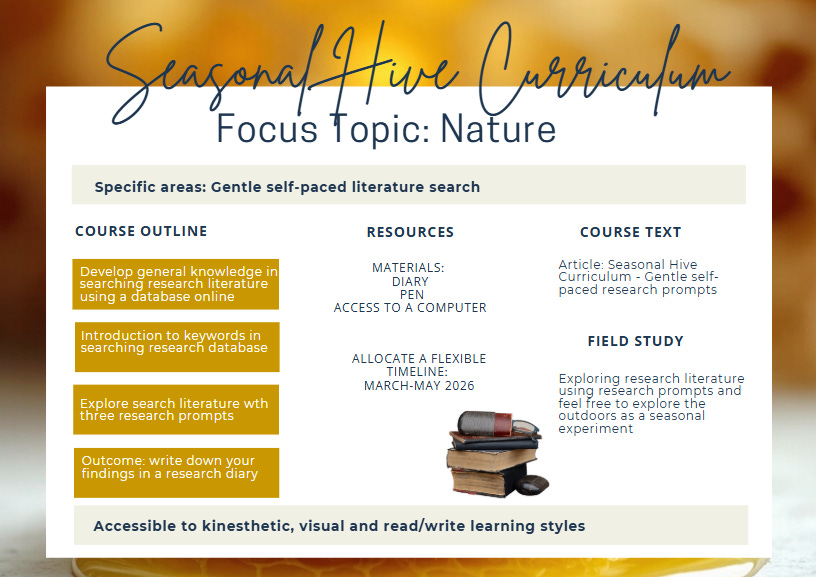
Focus Topic
As autumn loosens its golden hold, the world seems to exhale with a long, tired and gentle breath that invites us to do the same. The days thin into softer light, and in that gentle dimming, we’re offered a rare kind of spaciousness. This is the season for unhurried pages, for wandering through ideas the way bees drift through the last blooms of the year. With the year tilting toward stillness, there is room again to read deeply to research slowly, and to let curiosity settle where it wishes to, without rushing or demanding.
Introduction: Research prompts for deep reading
Reading gently strengthens our writing in ways that feel subtle at first and unmistakable over time. It widens the rhythms we can hear, deepens the vocabulary we can reach for, and gently expands the shapes our sentences know how to make. When we read attentively whether it’s a novel, an essay, or a line of poetry we absorb other authors words and thoughts that later surface in our own work. It’s less imitation and more absorbing knowledge, style of writing by being immersed in it. The mind learns by example, and reading gives it a steady stream of possibilities to draw from. Jouhar and Rupley’s study found that ‘independent reading enhances the overall quality of narrative’.
I also wonder if what we read influences us too.
When we decide it is to further deepen our reading we begin by searching for what to read next, we turn to literature, blogs, books that inspire us to write. It can feel a little like stepping into a vast meadow without a map. Keywords become our tiny pollen‑grains of meaning that help us trace a path through the field of literature. Each word we choose carries its own meaning and connection to research published in specialist journals, guiding us toward those studies, stories, and insights that resonate with what we’re hoping to understand. In this gentle way, searching becomes less about chasing information and more about following curiosity, one soft, deliberate word at a time.
I wish to gently encourage exploration of this largest research databases available absolutely free to the public, set up an account and start exploring these research prompts.
If you feel you would like to learn more about searching databases, in particular google scholar, here is a handy how to guide for you to explore.
Field Study
This field study can take you outdoors or keep you warm and cosy indoors with your favourite cosy blanket and a warm drink. In researching trauma education my mind moves in different directions. These three research prompts will lead you to literature and readings that will deepen your knowledge of healing, allowing you to explore the field in a gentle, slow way with a loose timeline, if one at all.
Idea 1, the role of slow and rhythmic movement of nature.
Waves, wind through grass, bees in flight explore how rhythm affects the body’s sense of safety. Try research prompts: body movement, leg, arm and head movement, tapping, outdoor wellness, clapping, stomping, music, low frequency, dance, tai chi, nature, outdoor living
Idea 2, explore how colour in nature affects our mood.
Choose one colour you are noticing this season and learn how it interacts with perception of feeling calm or perhaps it gives you joy. Try research prompts: colour and mood, psychology of colour, nature and mood, art in health, art healing.
Idea 3, explore the concept of “safety.”
Learn how tiny cues in nature warmth, stillness, birds singing, rain or breeze can be felt in the body. Try research prompts: safety in relationships, cultural safety, psychological safety and online safety.
Honouring the Experience
When we begin searching the literature, our keywords become like tiny researcher bees each one carrying a fragment of meaning that helps us navigate the vast field of research. These small words hold surprising power: they guide our curiosity, shape the paths we follow, and gently gather the information we need. Choosing them with care turns searching into a softer practice, one where we listen for the terms that feel true to our inquiry and let them lead us, slowly and steadily, toward deeper understanding.
Research diary: Keep a diary filled with these tiny words, meanings, leads to literature you have discovered. Return to these again and again when you get that tiny spark of an idea.
On a closing studio note, research prompts are important in the field of finding and searching for literature, another reason I keep them safe and refer to them from time to time to prompt me gently what key words and prompts I used to follow up on that rabbit hole of an idea. Enjoy your research journey.

If you have been stung by some learning mojo energy and wish to keep buzzing through my articles, here are some you may like to discover:


Love these, Katerina! So thoughtful.
these prompts really intrigue me actually - keen to try a few out!!