

Hive Curriculum: Nature-based writing prompts
Autumn continues in a gentle autumn field‑study guide with nature‑based writing prompts, sensory grounding, and slow‑paced reflection to deepen connection with the season.

Dear Beezee Bees
As autumn settles further into the season and the hive continues to hum softly immersing itself into literature lost in the words of knowledge, questioning why we know what we know again and again. This is the part of the season where the bees begin to sort the emotional pollen they have gathered and gently retreat into writing and noticing.
We all learn, feel, and understand the world differently, there is no universal truth. What feels right for one of us does not make sense for the other and feels more overwhelming for the next. It feels like our histories, cultures, and ways of processing our world is shaped by the environmental spaces we move through every day.
We use labels freely to create meaning of our experiences and make sense of each other’s actions, words and social world. We are all human and we feel, experience and think differently and that is worth celebrating.
We meet in a common place called ~ humanity.
Honouring differences, our sensory needs, our learning ways, our emotional canvas opens the door to more opportunities in spaces we enjoy and experience joy, hope and courage. It is a gentle reminder that the world becomes kinder when we are accepted exactly as we are with all our human imperfections.
Focus Topic
Re-imagine Autumn as a book that writes itself slowly chapter by chapter. It is not a guide, it’s a story written in the wind, the trees, the sky and waters. A story unfolding around us, asking us to be read with our humanly consciousness.
This next part of the Autum curriculum invites you to step into that consciousness and that story, not as an observer, but as a human being woven into the landscape that is your canvas.
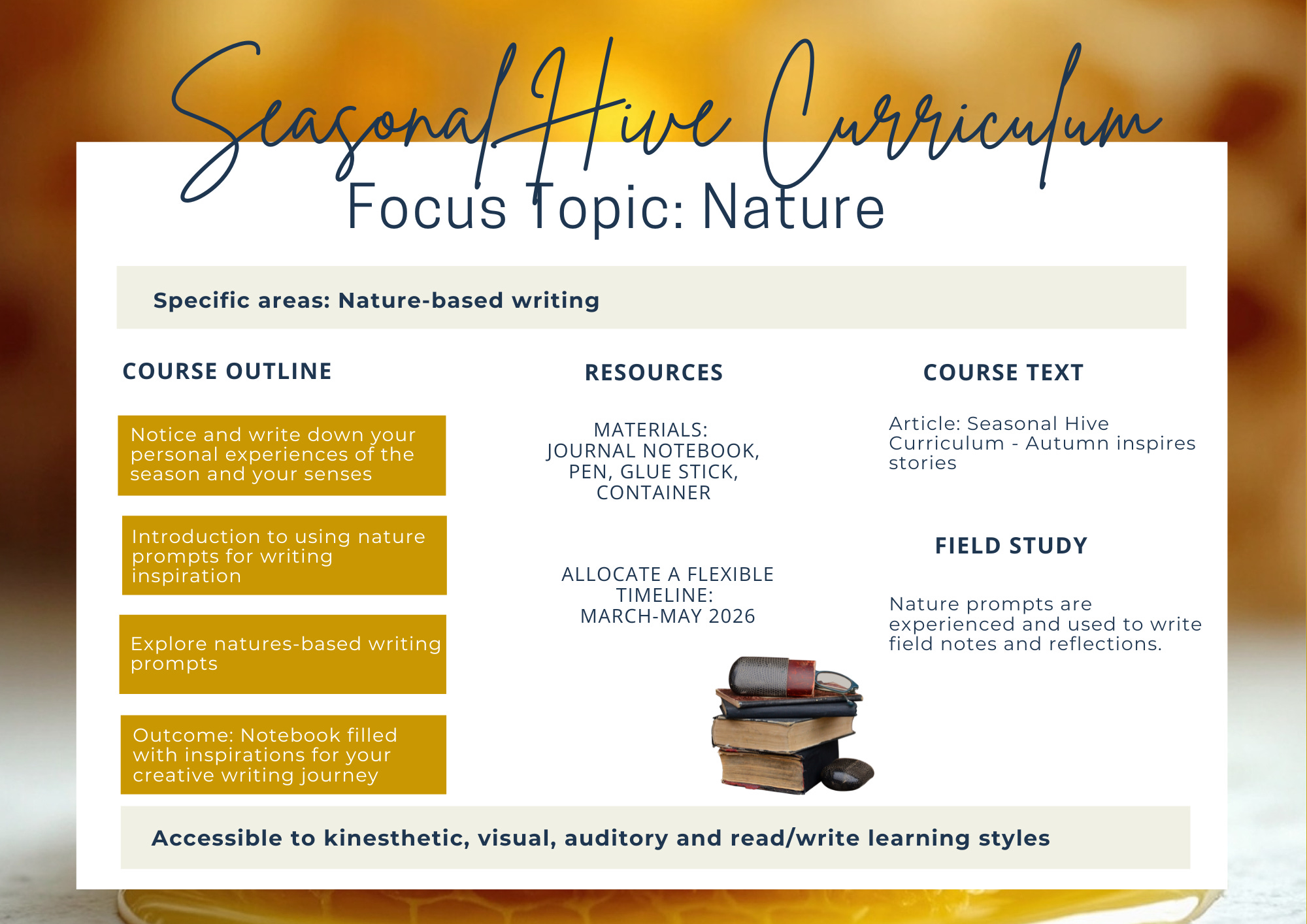
Introduction: Nature prompts for writing
Writing in nature is less about capturing the world and more about letting the world reveal something we have not seen before. When we step onto a path and let the colours become emotional cues, the wind a line of dialogue, the light shadows a gentle narrator, our writing begins to move with the slow pace of the landscape. Each stone, leaf, tree, creature or texture we touch becomes an artifact of our story, a reminder that the natural world is always offering metaphors, always inviting us to pause, notice, and translate its gentle lessons into words with meaning. In this way, writing becomes a kind of field study that is slow and deepens our connection to both the outer season and the inner one.
In many outdoor programs, writing is used to support learning, but it’s rarely invited in as a tool for deeper self‑exploration. The richness of the grounding of seasonal experiences paired with personal narrative. The focus is to pause and notice natural spaces, listen inwardly, reflect, and shape experiences into writing. It is aimed to build a small community of writers, learning the full arc of the writing process while discovering more about us and our human experiences. This curriculum has clear intentions, and a gentle cycle of observation, inner reflection and writing.
Humans have long been defined by our deep connection to rhythm in a song, in music, in dance, in the way we intuitively recognise patterns. New research shows we’re not alone in this ability, bumblebees, with brains no bigger than a sesame seed, can also learn and respond to abstract rhythms. This discovery softens the old assumption that rhythm requires a large, complex brain, and reminds us that even the smallest creatures move through the world with a surprising and intricate sense of pattern.
The rhythm of nature is everywhere.
Field Study
The field of nature already invites sensory exploration, but now we deepen it with written prompts to further develop our writing, inspired by nature.
Take a walk, drive or a moment to sit and simply be in nature as if we are stepping into a novel you are writing. Let the path be the plot. Let the sounds be dialogue. Let the colours be emotional cues. Notice our being, a sensory trail, choose one, let it guide our entire reflection. Pause and immerse ourselves in the moment as though this moment were the first chapter in our book…. take a moment…write down the title for the chapter…in the notebook.
Gather items from nature to represent our artifacts of our story. Place them gently into our pockets, basket or field bag. Pause and notice the shapes, surfaces and textures of the artifacts. Take field notes of our observations, emotions and textures.
Take photos of nature’s creatures, birds signing, bugs hiding, butterflies flying and bees gathering pollen from flowers. Pause and notice the colours, ecosystems and activities of the tiny living. Write down field notes of observations, emotions and rhythmic movement of creatures.
Honouring the Experience
While in nature, allow time for a mini retreat from the daily beezee life;
The breath, slows, deepens and grounds us into the present moment.
I close my eyes, but sometimes I feel like lowering my gaze instead, if that feels right, and I let my shoulders soften just a little. I take a slow breath in and feel the air move gently through my body, then let the exhale fall out without effort. I breathe again, a little deeper this time, as if I’m giving my nervous system a small place to rest. With each inhale, I arrive more fully in this moment; with each exhale, I release a little of what I’ve been carrying. My breath becomes the anchor that steadies my inner hive, reminding me that I can return to myself, one soft breath at a time.
Time in nature may offer a sensory soothing while also feel restorative.
I take a slow breath and let myself settle, feeling my body soften into this moment. As I breathe in, I notice how nature around me moves at its own unhurried rhythm — the way leaves drift rather than fall, the way light shifts quietly across the day, the way the air cools in small, almost imperceptible steps. I let myself match that pace, allowing my breath to lengthen, my thoughts to loosen, and my awareness to widen. With each inhale, I arrive a little more fully; with each exhale, I release the need to rush. I let the slow pace of nature guide me back to myself.
Gather our field notes filled with nature-based writing prompts, and titles that reflect our experiences and start re-writing them into stories that are personal, imaginative, creative and grounded in reality. Find a quiet spot under the tree, in a field of flowers or on a bench by the sea to immerse ourselves into our writing practice.
On a closing studio note, connection to nature is a not a new idea, but a gentle reminder that it is a gentle way to restore ourselves from a life that feels too fast, too loud and too beezee. Creating time to reconnect and return to ourselves feels nourishing, accessible and kind to ourselves.

If you have been stung by some learning mojo energy and wish to keep buzzing through my articles, here are some you may like to discover:


I loved the idea of letting the landscape guide the story
I love the prompts, thanks for sharing! ☺️