


Research is something that everyone can do, and everyone ought to do. It is simply collecting information and thinking systematically about it. - Australian sociologist Raewyn Connell.
This quote by Raewyn Connell really keeps me going. Thinking back on my two years in the program and I actually thought and felt quite the opposite, my view has changed.
This change in view has led me to this post where new thoughts and ideas about a topic are easy to collect, note in a notebook or follow the curious pull wherever it may pull you. Learning and researching ideas now are less like a task and more like a gentle question that I ask myself when I see an idea in my data, it is an invitation to follow my curiosity wherever it naturally drifts to, but I set limits.
In life I have found myself going down various rabbit holes, and this felt okay and absorbed a lot of my time with nothing to show for it, just more ideas and more rabbit holes.
PhD Journey
In my graduate research these rabbit holes need to circle back to my central research question, this forces me gently to maintain my focus. Here I give myself permission to pause and ask myself how does this related to answering the central question? why does this matter to me here and now? It gives me permission to slow down and reflect, work out what needs my energy and attention in the moment, I notice what pulls my attention and questioning it. In research and learning new ideas and concepts becomes softer, kinder, adventurous and playful. I let my curiosity move in the direction of my purpose of answering my research question.
I’ve learned that my mind doesn’t follow straight lines it loops and wanders off track. My learning is creative and a little unconventional, the kind that starts with one question and tumbles into five more before I’ve even finished the first paragraph. I follow sparks: a sentence that makes me pause, a contradiction that irritates me, I return to it and rewrite it few more times before moving forward. I look inward, outward and forward, something I wrote about in earlier articles.
I don’t try to make it elegant anymore. It is the tension I hold between my imperfection and the need for perfection.
I include many curious wanderings into the first few drafts and then filter through revision, after revision to find the clear path. I wonder if this makes me appear clueless or not clearly understanding concepts and complex ideas. I just have so many questions.
Your Mini-Guide
Think of this mini-guide as a gentle companion sitting with you in time of writing, reflecting and movement towards finishing your next piece of work.
Here are ten ways I remain actively engaged in my learning as I explore ideas in my data;
Start with an idea, what matters to me, what do I want to know more about this idea
Ideas appear from my data, what participants have said, felt or wondered. Through this methodology I am able to follow these wonderings and explore them further. These have taken me down many rabbit holes which feels indulging but not productive. I move towards writing my ideas in keywords and phrases into my research diary instead. These don’t make sense to me at the moment. I’ve learned to trust that early messiness or abstraction of ideas, because it’s in that loose, wandering space that the most interesting connections start to appear.
I develop a question from the ideas I have gathered
I begin to wonder what is it that I want to learn about, what am I seeing, what do I need to know about the idea or topic. I start asking myself and thinking about the questions. Scribbling them down and reshaping them takes a little playful time, but this part is important. I play Thinking about you by Dustin Lynch and MacKenzie Porter to get me thinking.

I become curious about what I read and question this continuously
I have spent most of my teenage years in public libraries and I recall sitting in a book aisle researching a topic of personal interest and reading books beyond my comprehension. This included scientific books, articles, research papers, newsletters, blogs and even the odd sentence that catches my eye in a place I didn’t expect in quotes. I still remain this curious and wonder about topics. Each source gives me a different texture of insight: some are dense and technical, others light and conversational, some create discomfort and some move me, many sit somewhere in between. I like moving between them, asking the question I want answered, remaining curious and open to different ideas. In this stage I give myself a timeframe that feels right for me and my timelines for managing this project.
I batch my sources of readings together
Saving time is a skill motherhood taught me, I batch a lot of tasks like appointments, planning kids’ activities, paying bills, meal prep, it’s a way of life for our family, that is how we keep moving forward. So, I transferred this knowledge and skill into my research, I started to batch read or listen to audio versions of research articles, books, podcasts and then give myself time and space to absorb, process and reflect on what I am learning from different sources. I group these into scientific, practice, meetings and grey publication categories.
Recording my thoughts and understanding about what I am learning
I return to my central question here again before I start writing notes and note it on the top of my page. This keeps me returning back to my purpose and my ‘why’. Notetaking is a personal choice; I have taken messy notes from conversations to structured note taking for literature reviews or annotation of book chapters. This part is personal. One thing that remains the same I keep a record of these thoughts returning to them later to rewrite and shape the story that emerges. It’s a living process, one that lets my curiosity wander while still gently guiding me back to what matters - the meaning making, the central question. This keeps me active in the learning process. I stop researching before the information before it turns into a spaghetti bolognaise.
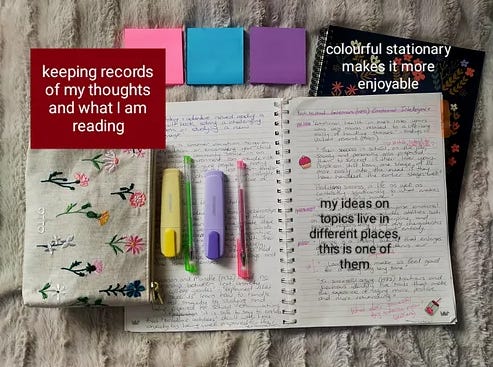
The messy first drafts this is when I make sense of the ideas first
The first draft is when I let my creativity flow, random thoughts and wonderings about the topic and potential answers to the questions. I recall getting lost in my writing and the creative flow. These days I stop after 30 minutes. Sometimes 60. It preserves my energy. It is my circuit breaker.
Understanding my own lens and how I view the ideas
As a constructivist researcher I have a lens that is shaped by my own values, professional values and personal experiences of a refugee, this enables me to view a topic from that particular lens and worldview. I have the belief that people do not just receive knowledge they build it through their experiences, interactions and interpretations. Instead of looking for one fixed truth, as a constructivist researcher I strive to understand how different people make meaning in their own worlds. I pay close attention to context, personal perspectives, and the way ideas evolve over time. In simple terms, I study how humans construct understanding, rather than assuming knowledge exists independently waiting to be discovered.
This is the time I start to shape my ideas on the topic
Now I am meaning making, closely examining who says what about the topic and what lens and perspective they are viewing the topic. I am making sense of the idea and topic. I am also comparing what has challenged my thinking, beliefs and values about the topic. I write down other experts in the field that either share or disagree with the idea, or perhaps they look at it from a different lens.
I continue to find myself questioning my data and what I am reading all the time, it sometimes feels critical, inquisitive and skeptical like I am interrogating the data in the courtroom
Reflexivity leads me to critically interrogating what I am learning what I am seeing in my data. This keeps me actively thinking and learning in my research but in a slow thoughtful way. It’s really about slowing down the words in my head enough to notice the assumptions I am carrying and gently asking whether they still hold up, and for who, whose voice am I using. It’s the practice of pausing when something feels too uncomfortable or different and turning it over to see what might be hiding underneath. Challenging assumptions doesn’t mean dismissing everything or criticising others it means staying open, curious, and willing to let your understanding widen as I encounter new ideas in my data. This part often feels like an episode of Law and Order, SVU. I love that show.

Law and Order Courtroom Scene: The Interrogation of Data
This is the part that gets me to finally write it, shape it, review it and reshape it on a page
This part feels the most rewarding, not every idea deserves to be in my thesis, not every topic deserves my attention, I need to get critical here, those that do land on my page and I get to write them in a meaningful way. This is where, again, I circle back to my central question, the idea, the topic I am working on. There’s a gentle sense of achievement that what I am saying matters, and that saying it to someone will help them move forward with shaping their idea into meaning making. It turns writing from expression into impact, and you can feel that change in the energy in the words. I give myself a hard self imposed timeline here and send it off for feedback. No excuse. Press send.
On a closing fieldnote, thank you for being here with me and sharing this journey of learning with me. Actively learning how to research feels like riding a rollercoaster more than a gentle practice. However, learning to be gentle with myself along the way is what keeps me returning. It also reminds me to keep activity participate in my knowledge, learning and growing… even when it feels difficult at times.
Continue Reading…

This was a great reflection of your PhD journey- i like how it has transformed learning from a task into a curiosity-driven process for you - and bveing prone to "rabbit holes" you've learnt to balance creativity and exploration with focus.
Yes, I really get this. Research sounds like something anyone can do, and in some ways it is. But doing it properly is a different thing.
I also know the rabbit hole part so well. You follow one idea, then another, then suddenly you have ten more questions. I think the skill is learning when to follow the curiosity and when to bring yourself back to the actual question.
The messy drafts, the questioning, the going back to the data again and again....that all felt very familiar.