


Dear friends, thank you for being here and reading,
Have you ever received a text like this?
Text: “We need to talk”
Senders’ intention: I want to discuss something important.
Recipients’ interpretation: relationship problems, potential breakup, work issue, sex catch up, brace for an argument, have I done something wrong, sad or bad news, exciting news or time for a face-to-face catchup.
Misunderstandings are one of humanity’s most impressive talents.
I want to present this as intersectionality in communication. Intersectionality isn’t talked enough about, we often read more popular forms of understanding of content and text communication, we banter about differences between the sexes, ‘men are from mars and women are from venous’, we box people into various diagnosis and abilities to determine a set of ‘criteria for inclusive communication’. Advocacy aims at single method of inclusion, excludes someone else that doesn’t fit in that box.
Intersectionality highlights that communication is never entirely neutral. Language reflects different positions in life such as race, gender, disability, class, culture, and sexuality, the same words can evoke different interpretations and emotional responses. This helps explain why online communication often produces disagreement over meaning, even when all parties are responding to the same text. Certain perspectives may be privileged within books, media, educational materials, and public communication, while others remain marginalised.
“Intersectionality […] is often reduced, in common understanding, to a due consideration of the various axes of oppression and privilege: race, class, sexuality, disability, and so on. […] The central insight of intersectionality is that any liberation movement feminism, anti-racism, the labor movement that focuses only on what all members of the relevant group (women, people of color, the working class) have in common is a movement that will best serve those members of the group who are least oppressed.” - Amia Srinivasan
An intersectionality viewpoint is essential in globalised societies, online platforms, where communication frequently occurs across cultural, linguistic, and social boundaries. Acknowledging multiple perspectives, readers can engage more critically and empathetically with written texts. This diagram provides a visual understanding of how intersectional relationships in communication connect with each other.
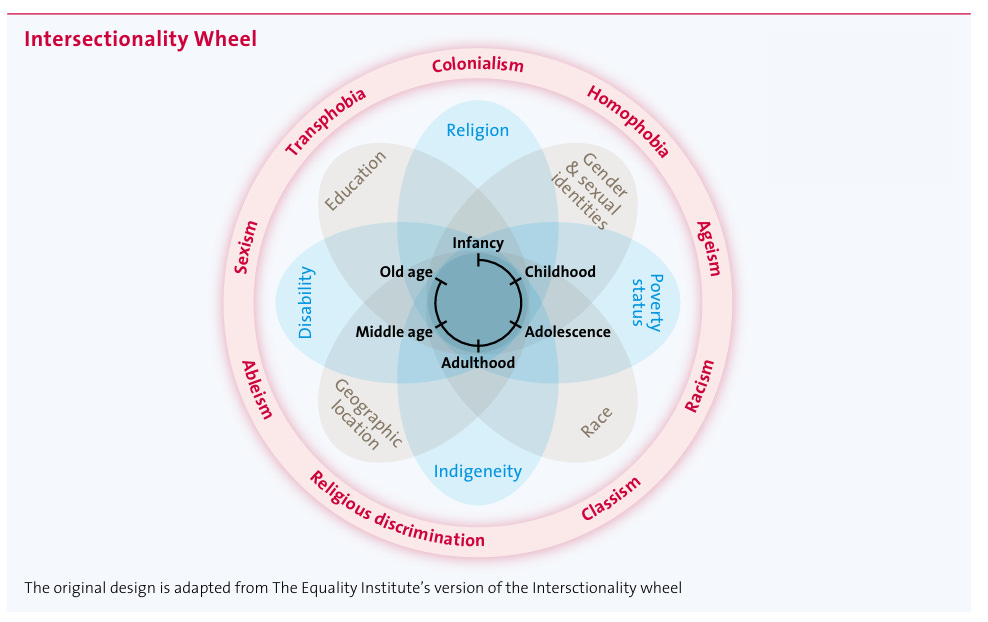
United Nations Source: Intersectionality Wheel
Intersectionality originated in African American feminist scholarship in the United States and has since become an important framework for understanding how race, gender, class, culture, and other identities shape communication. Used widely across the United States, Canada, Europe, and Australia, it helps researchers examine how power, diversity, and social position influence the creation and interpretation of media, public discourse, education, and workplace communication. An intersectional perspective recognizes that people may interpret the same message differently because meaning is shaped by the interaction of language, identity, culture, and lived experience.
In digital communication, terms such as ableist, racist, sexist, or transphobic are often interpreted through an intersectional lens. What one person intends as humour, description, criticism, or casual expression may be perceived by others as reinforcing systems of marginalisation. Intersectionality suggests that these differing interpretations arise not only from the text itself but also from the identities, experiences, and social contexts that readers bring to the interaction. This helps explain why the same words can generate very different responses among audiences.
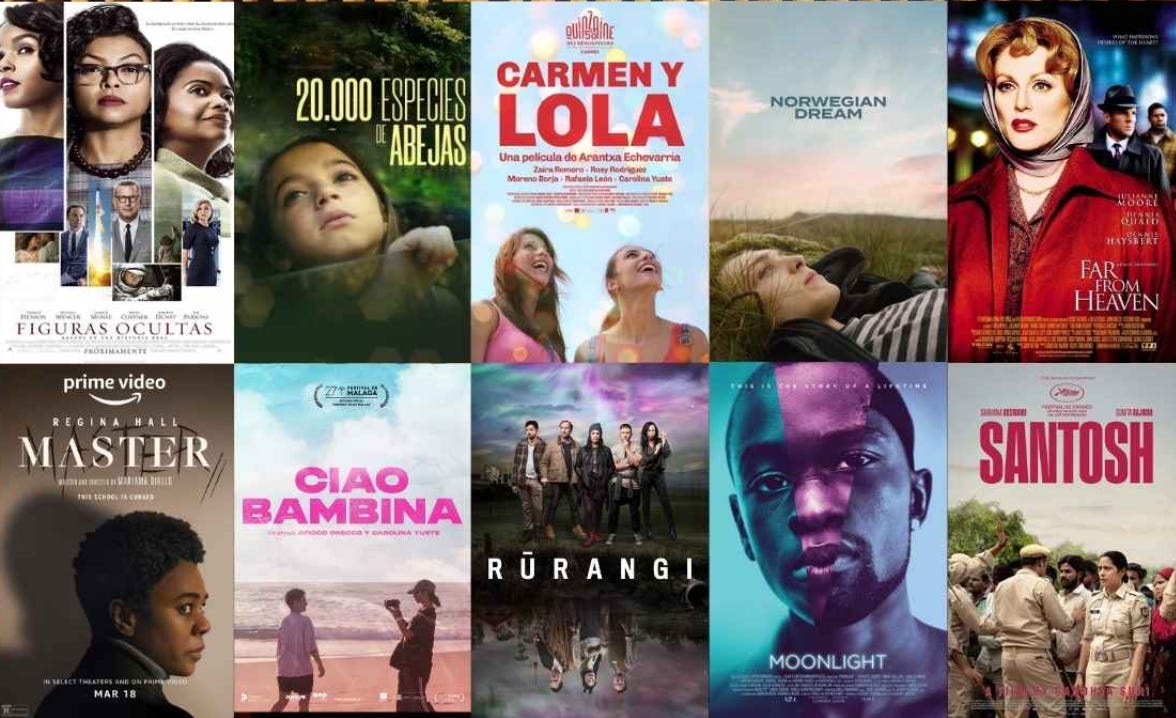
The movies below explore intersectionality in various ways.
“The more technologically advanced our society becomes, the more we need to go back to the basic fundamentals of human communication.” — Angela Ahrendts
Texting is such a simple communication tool. Or is it?
Unlike face-to-face conversations, texting removes many visual understanding, social cues, forcing the brain to interpret meaning in different ways.
Therefore, it is far more complex than in person conversations.
In everyday conversations, people rely on tone of voice, facial expressions, and body language to understand meaning. When these cues are missing, the brain must “fill in the gaps,” which often leads to ambiguity. A simple message can be interpreted in multiple ways depending on the reader’s mindset. The brain uses prior experiences, emotions, and expectations to interpret words. This is known as top-down processing. For example, if someone is feeling anxious, they may interpret a neutral message as negative, even if that was not the sender’s intention.
Text also creates a sense of emotional distance. Without physical presence, people may feel less socially restrained, a phenomenon known as the online disinhibition effect. This can lead to more open and honest conversations, but it can also result in misunderstandings or harsher communication than intended. Timing is another important factor in texting. The speed of responses can influence how messages are perceived. Quick replies are often interpreted as interest or engagement, while delayed responses may be seen as disinterest or avoidance. This shows how even silence in digital communication carries meaning.
To compensate for the lack of nonverbal cues, people use symbols such as emojis, punctuation, and abbreviations. Emojis, in particular, serve as emotional signals that help clarify intent, confuse or intensify the text. Research suggests that the brain processes emojis in ways similar to facial expressions, helping restore some emotional context. Memory and attention also shape text because messages can be stored and revisited, individuals may reread conversations to seek better understanding if they choose to. This can improve communication, it can also lead to over analysis and increased anxiety, especially when interpreting messages.
While misunderstandings are inevitable in text-based communication, repeatedly claims of not understanding the other person can be interpreted as disrespectful towards the other person and can damage the ability to develop trust and maintain the relationship.
Holtgraves 2021 study found that miscommunication is common in digital platforms because people often soften face-threatening messages, such as criticisms, demands, or threats, to avoid offending others. This politeness makes intentions less clear, causing recipients to misunderstand the intended meaning. The study also found that people are generally overconfident in their ability to communicate effectively and often fail to recognize when miscommunication has occurred. Overall, the research shows that meaning is not only influenced by words but also by social relationships, context, and concerns about maintaining positive interactions.
Tezcur and Vitanova 2024 research findings suggest that messages are not interpreted solely through their words but through the social identities and experiences of both the sender and receiver. An intersectional perspective highlights how factors such as race, language background, culture, gender, and perceived linguistic understanding determine how digital messages are written, interpreted, and read. In online spaces, the same text can be understood differently depending on a reader’s social position and assumptions about the person behind the message. This challenges the idea that digital communication has a single, universal meaning and instead shows that meaning emerges through the intersection of language, identity, power, and lived experience.
Wadge et al. 2019 explores if successful communication depends on communicative alignment, the ability of individuals to develop a shared understanding of meaning through ongoing interaction. Their research found that autistic individuals could generate and interpret communicative signals effectively but experienced difficulties when meaning relied on shared contextual history. The study highlights that meaning is not contained within words or signals themselves but emerges through the collaborative process of negotiating understanding between both people. Therefore, communication is shared responsibility, and both individuals need to commit to the process of maintaining the relationship.

On a closing fieldnote, perhaps the greatest lesson of understanding language and text in the context of intersectionality is how to accept differences for they are.
I wonder what a world without the intersectional differences would look like. Where tensions would be non-existent, no curiosity in sight and no hilarious and mildly embarrassing moments to giggle at.
In a world where everyone is exactly the same, individuality would become a huge trend.
Continue Reading…

References
Cole, E. R. (2009). Intersectionality and research in psychology. American Psychologist, 64(3), 170-180.
Crenshaw, K. (1989). Demarginalizing the intersection of race and sex: A Black feminist critique of antidiscrimination doctrine, feminist theory and antiracist politics. University of Chicago Legal Forum, 1989(1), 139-167.
Crenshaw, K. (1991). Mapping the margins: Intersectionality, identity politics, and violence against women of color. Stanford Law Review, 43(6), 1241-1299.
Holtgraves, T. (2021). Understanding miscommunication: Speech act recognition in digital contexts. Cognitive science, 45(10), e13023.
Hyde, J. S. (2005). The gender similarities hypothesis. American Psychologist, 60(6), 581-592.
Kelly, L., & Miller-Ott, A. E. (2018). Perceived miscommunication in friends’ and romantic partners’ texted conversations. Southern Communication Journal, 83(4), 267-280.
Rhodes, C., Pullen, A., & McEwen, C. (2023). Leadership Diversity Through Relational Intersectionality in Australia: Research Report. University of Technology Sydney.
Tannen, D. (1990). You Just Don’t Understand: Women and Men in Conversation. New York: William Morrow.
Tezcur, N., & Vitanova, G. (2025). Intersectionality between race and nonnative English speaker status in language teacher identities: What educators should know. RELC Journal, 56(1), 184-197.
Wadge, H., Brewer, R., Bird, G., Toni, I., & Stolk, A. (2019). Communicative misalignment in autism spectrum disorder. Cortex, 115, 15-26.
Wu, B., Zheng, H., Patel, S., & Goff, W. (2026). Diversity and inclusion in the Australian Early Years Learning Framework: multiculturalism, interculturalism and intersectionality. Early Years, 46(2), 221-236.
Wood, J. T., & Fixmer-Oraiz, N. (2026). Gendered Lives: Communication, Gender, and Culture (14th ed.). Cengage.
Thank you for forwarding this to me. I find my humour sometimes gets lost on here. Five people will laugh and one will come from left field and I think that maybe they are looking through their own lens in what they are experiencing that day. And that's ok.
Just last night I got a DM asking if I was ok after a comment so can totally relate to this. For me, yes, I was probably coming across less emoji enthusiastic, but I'm feeling super peaceful this week.
Delayed responses used to put me in a spin, but as I get older, I realize people have their own priorities and lives and if it's important I'll call.
To be honest, I didn't realize this had a term or it was studied, I just thought that was part of being human so it was a fascinating read!
Thank you Katerina! 🧡💗🧡
Beautiful piece, Katerina. I loved how you connected it to intersectionality and the way our identities can shape how we interpret every kind of communication, from written words to someone’s tone or facial expressions. We often assume visual cues make the meaning clearer, but I’m not sure they always do. We still read them through our own experiences, beliefs, culture and assumptions about the other person. I sometimes find myself analysing even the meaning of an emoji attached to a text. My mind rarely takes one simple meaning from anything. 😅