

Rediscovering My Learning Mojo (It Was in the Hive All Along)
Returning to study in my 40s has taught me a lot about the art of learning and writing.

Hello Beezee Bees,
I wanted to share that the gap between my undergraduate studies and now a doctorate is approximately 15 years of practice (this means no academic study). I am a learner again! I had plenty of opportunity to engage in learning in the context of professional development, reading journal articles to keep up to date with the latest knowledge in the field and fellow practitioners, practicing critical thing. This work re-engergised me and was a big part of my self-care plan. However, during my doctorate I am engage in a large volume of academic reading, research journals and other expert voices. Right now, I am learning to develop my own writing voice.

My deep seeded value and belief that we are all lifelong learners is one of the motivating factors for writing these articles. Rediscovering my learning mojo and find my voice using a social and creative way to express my written ideas. The image below is the representation of how I feel [sometimes], there is so much to read and learn and write about… where do I start! how often do I write? what do I write about? what schedules do I follow?

A Little About Motivation First
I see myself as completely intrinsically motivated to create a fulfilling career and life with my family. I have learned about motivation way back during my undergraduate studies, I have seen it in practice with those I served and practiced with, and I felt it personally on daily basis.
I would best describe motivation as two influencers one is named ‘intrinsic’ that influences you based on what your personal curiosity, dreams, hopes and wishes are, and the second influencer is called ‘extrinsic’ that drives you buy external rewards like money, exciting opportunities or grades.
Research consistently shows that intrinsic motivation such as curiosity, enjoyment, or a sense of personal meaning supports deeper engagement, persistence, and long‑term wellbeing, whereas extrinsic motivators like grades, praise, or financial incentives can boost short‑term performance but may undermine internal interest when overused. A review by Wendy Repovich highlights that although both forms of motivation rely on reward‑based processes, intrinsic motivation is associated with distinct neurocognitive patterns linked to autonomy and internal reward valuation.
Educational studies further suggest that learners driven primarily by extrinsic rewards may focus on performance outcomes rather than engagement in the content, sometimes leading to surface learning or even unethical behaviours such as cheating or letting AI write their assignments. Understanding how these motivational systems interact helps educators, professionals and learners balance necessary external incentives with opportunities for developing new knowledge, skill, competence, and meaning.
Learning at My Age?
OK let’s confront agism first! I don’t actually feel or think I am that old to learn again… BUT a break from the learning environment and a busy life with kids has really caught up to me! So, this part of the learning journey was particularly confronting because I have met doctoral students in their 20s living at home with an awesome support system and all the time in the world to dive into their research project with no mortgage, no children, no aging parents and no responsibility. I guess I am part of the sandwich generation, meaning caring for children and their parents (or generation X). Therefore, stepping back into learning as a mature‑aged adult felt both grounding and disorienting, as if the habits that once carried me through professional development activities at work no longer quite fit who I needed to be - academically.
I discovered that relearning how I learn was a natural response to a life that has reshaped my priorities, attention, skills and sense of self. Experience has given me depth, but it has also layered me with responsibilities, biases, and well‑worn patterns that do not always serve me in a contemporary learning environment. I realised that I needed to approach learning with more curiosity and compassion than I did in my younger years during my undergraduate degree. It was less about ‘getting it right’, written essay or a good grade and more about understanding how my mind works today, trying out different strategies and being open to learning ( or practicing my growth mindset as Dr Dweck would suggest). This process felt at times strange and uncomfortable, letting go of outdated strategies, experimenting with new ones, and trusting that growth at this stage of life is not only possible but profoundly meaningful, to me.
My Writing Journey
I was so excited at the end of my undergraduate studies not to have to write another essay EVER again! It was so inspiring! The only writing I engaged in was in my journal, case noting and letters of advocacy. I later found the love for creating brochures, information sheets and writing how to guides. These little actions of inspiration turned into ethics applications, reports, providing students with feedback on their written work and now a book chapter.
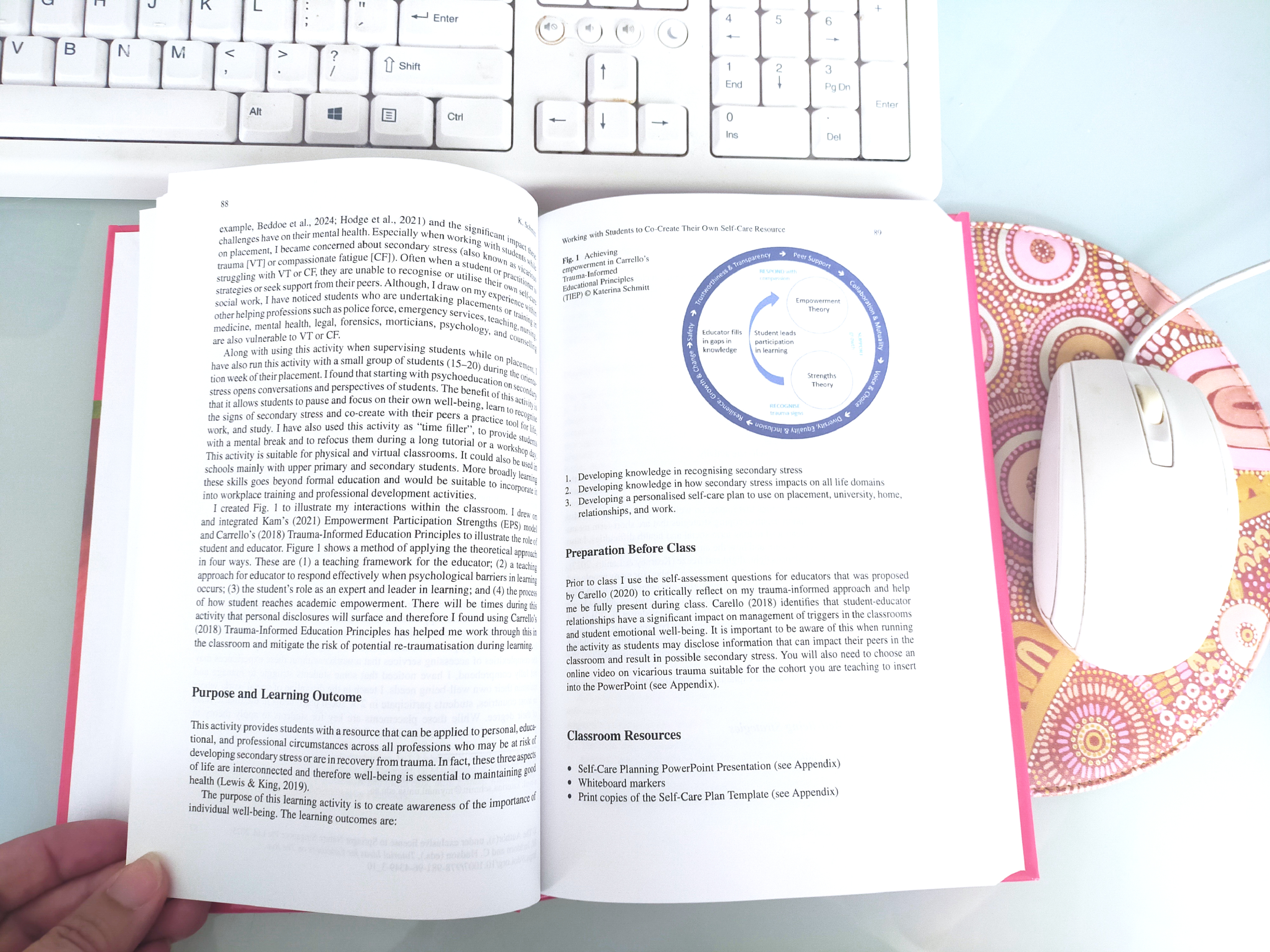
Book Chapter in Tutorial Ideas for Educators on the Run. Working with Students to Co-Create Their Own Self-Care Resource | Springer Nature Link
On a closing studio note, I realised now that I didn’t lose my writing skills or my voice, instead I just forgot how capable I already am. The writing ability, the insight, the way I can shape ideas into something meaningful… all of that is still there, quietly waiting for me to tap back into it. I now view writing as a practice it something that grows with me the more I write. What I actually needed now isn’t a reinvention of myself but a refreshed set of strategies and tools that fit who I am at this stage of life, filled with family, children and responsibility. It now feels less like starting from scratch and more like starting from experience. With a few new tools in my learning toolkit, and some gentle momentum from the Substack community, I feel those old strengths are waking up again, ready to carry me forward in a way that feels both familiar and completely new. Writing for me has become my self-care strategy that has anchored me creatively, some notes are saved in ‘draft’ and some notes I share. Thank you for coming on this learning journey with me.

I love and support this so much! I will always say I will be a lifelong learner. Wishing you do much success and joy!
Well said, my friend! Writing is also my passion, but when I finished with my doctorate, I was burned out on writing despite having a graduate goal of publishing every year. When you return to write (and that passion does come back), it is nice to realize you still have the ability, and your voice may even be more present than it was before. Great work, and thank you for being here.