I Thought Compassion Meant Buzzing Until I Burned Out
I thought compassion meant giving everything I had. At the end I was running on fumes, wondering how professionals survived this work without losing themselves.

Dear Beezee Bees,
Giving everything I had was my new pattern I started to develop early as social work student many years ago, at that time, I had a full-time job, I bought my first house and no family to anchor me. BUT I had energy, passion and eager to soak up all the knowledge I possibly could at any given opportunity.
I recall a defining moment in my undergraduate studies and as a working professional when I collapsed into a sobbing mess over an assignment deadline. It turned out my body had limits!
Reflecting on my early years of my social work career my favourite moments I recall were those where connections we built with individuals and families. I gave everything I had; I stayed up late at night after dinner and read research articles, lived experience stories and had a long list of service provider resources so I could show up for those individuals every day and hold their pain, support with compassion and access to real practical solutions that made a difference positive difference in their life. Those were the days when my whole hive‑heart was in the work.
Trueth be told, those connections made a profound difference in my life too.
I specifically recall sharing the lessons I have learned along the way with social work students, parents and carers I was working with the quote that carried me as my anchor during this meaningful work "Be there for others but never leave yourself behind" is attributed to Dodinsky. This quote became my mantra, my reminder, how important the work of caring as and part of this work is remembering my own needs.

Cost of Caring for Others and Ourselves
Social workers develop their foundational skills and knowledge how to care for others during their studies. They go on to partner with individuals, families, groups, and communities to address both personal difficulties and systemic barriers that affect wellbeing, these are often associated with;
housing stress or homelessness or unsafe home environments
mental health and emotional wellbeing
addiction, alcohol, or other drugs
domestic and family violence
poverty and financial hardship
discrimination and social injustice.
Holding and staying in that discomfort while acknowledging our own privilege is what social workers do | AASW. I read this article Running on Empty: Compassion Fatigue in Health Professionals by Françoise Mathieu who I wanted share and quote a specific section of this paper:
“Compassion Fatigue has been described as the “cost of caring” for others in emotional and physical pain. (Figley, 1982) It is characterized by deep physical and emotional exhaustion and a pronounced change in the helper’s ability to feel empathy for their patients, their loved ones and their co-workers. It is marked by increased cynicism at work, a loss of enjoyment of our career, and eventually can transform into depression, secondary traumatic stress and stress-related illnesses. The most insidious aspect of compassion fatigue is that it attacks the very core of what brought us into this work: our empathy and compassion for others.”

Source: What Caring for Others Can Teach Us About Taking Care of Ourselves - Inkblot Arts
Signs and Symptoms
I started to notice fatigue signs in me, low energy, restless sleep, losing interest at work or home, feeling helpless and generally not my usual self.

The one thing I have struggled as a social worker, and as a new mother (15 years ago) is time for myself, just me, so I can be present for those who need me at work and at home. I decided after a lengthy conversation with my supervisor (although I didn’t think I needed to at the time) to set up my very first self-care plan.
The Freebee resource I used at that time, developed by Blackdog Institute, ironically the title was fitting, and I had to read it: How to use self-care planning to improve your emotional wellbeing, even when you don't think you need it - Black Dog Institute | Better Mental Health. I found these resources useful but also familiar - because I would do this in my practice, and now I needed to create a plan for me that would stick and creating lasting inner change.
By this stage I had read several articles and books on compassion fatigue also known as vicarious traumatisation, secondary stress or burnout. Some of the authors included Charles Figley (recommended by a colleague), Heather Stringer, Kerry Schwanz, researchers Susan L. Glassburn, Kathy Lay, and Meredith Canada are currently exploring the lived experience of compassion fatigue and burn out in social workers, Amelia Mohd mapping the conceptual models, predictors and research trends in 2025. this was important to me because I wanted to understand it in depth;
defining compassionate fatigue
understanding its symptoms and impacts on me and others
mapping the research landscape (that’s for the nerd in me!)
exploring lived experience in social work and other professionals in health and education
recognising systemic and structural barriers (reality check for me!).


Image: Produced by AI Copilot - a portrait of me researching it is a close resemblance (this is a little bit of fun - for me, I have another article about using AI)
A Micro-Action: The Start
I was buzzing with motivation. I completed my template and then filed it away for another day. I was really proud of myself for thinking about me and completing the self-care template. I had a plan for when I needed it. After more fails, lows and highs, I realized self-care work like that. My self-care plan was designed to map out my personal needs and actions some that needed to happen every day and weekly, monthly or annually in all areas of my life. I decided to start small; micro infect, I took one micro action.
My very first micro-action - I committed to is taking a day off work on my birthday throughout my career. This commitment has lasted 15 years! When I started Learning Hive Studio, I wanted share how one micro action cross-pollinated and turned into several micro actions imbedded into my life.
To show this, below is my Creative Self-Care Checklist, this checklist has the creative micro-actions I took to boost my wellbeing.

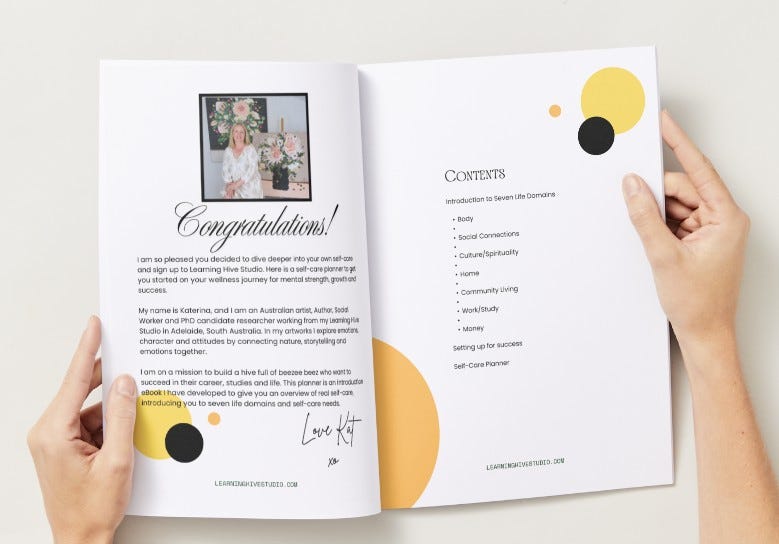
On a closing note, after completing all the creative self-care micro-actions that re-energised my bee wings. I wanted to make lasting changes in all areas of my life, I knew I needed to do more work here and find tools that were informed by research, proven to work for the individuals and families I have worked with. They needed to be practical and simple to use. Self-care needs to be manageable, actionable and sustainable through daily actions and based on everything I had read and learned from my experience. I developed a Self-Care Evidence Based Planner for you to make a self-care plan to start you on your journey.
Inside the planner you will find information about Seven Life Domains where micro actions need to take place to return to feeling and living like yourself again. Enjoy!