


Writing on Substack can sometimes feel like hosting a dinner party where nobody remembers to RSVP. You spend hours crafting a thoughtful post, hit publish, panic, edit the post, and sit and wonder if anyone will actually read it because they enjoy it or if commenting is their subscriber strategy. I reached a point in the journey where I didn’t know if I was writing or simply screening myself from the rest of humanity. It is surprising easy to feel alone while surrounded by so many creatives.
When I started this PhD journey, I was told from the start it was ‘isolating’, this didn’t bother me initially, I was so busy, no time to connect with new people. This year after quitting my job I started to feel it more and more. Writing my PhD Journal entries became more of self-exposure and self-love. The last three months I have been in limbo, I hit a brick wall, I just wanted to quit my Substack, do it in private, too busy, can’t do this anymore, too hard basket. Then I ‘mingled’ in notes and Judith expressed similar motivation levels. Thinking about it now, what I actually needed was meaningful connections with other writers and likeminded writing peers. To us a conversation felt like an act of self-love, we felt the instant joy, positive vibes and support from a fellow peer. The chat felt personal not a consultation.
Home is not a place, it’s a feeling. Cecelia Ahern.
We connected over life experiences that differ and yet feel the same, here, we both benefit from this connection in so many ways. I have been thinking about reaching out to her for some time but hesitated. I took it as a sign when she shared a story about taking time away from writing to focus on her new self-love, a black beauty, as she engaged in quine-assisted therapy. A journey of self-love expressed for herself is a long-term commitment and that was exactly the type of woman I wanted to get to know. We both share different self-love journeys and finding meaning for life after trauma is something that is rarely talked about.
The wounded mind must be reset like a fractured bone. It cannot heal itself without spiritual realignment. Anthon St. Maarten
Introducing Judith
My initial mission drew me to Judith and her story. I wanted to meet others and explore intergenerational histories of trauma and learn about their lived experience to see if it connected with my experiences or how it differed. I found her approachable, warm and wanting to get to know me, that felt authentic and very caring. Her professionalism, history, lived understanding of war-torn communities of Germany, a neighbour of Czech Republic, with long historical and ongoing impact of intergenerational trauma was grounding for me.
In our Zoom conversation the hour just flew by as we chatted about a lot of things. Judith may not identify this, but I thought her views were closely aligning with a feminist perspective on the impact of trauma, addiction and healing of women. Understanding these issues from a women’s lens with a wider sociological influence, psychological underpinning on individuals, communities and society gave our conversation depth. Her writing explores these wider perspectives including her own healing through equine therapy, yoga, lifelong learning, travelling and connection to nature. All acts of self-love. This openness and style of thinking deeply resonated with me and is very closely aligned with how I like to conceptualise traumatic experiences, write about this topic. I am looking forward to writing some collaborative articles on various topics, this gives me positive vibes and lots of joy.
Introducing Katerina
When Katerina first reached out to me, I was immediately impressed to be connecting with a woman who is working towards her PhD. Academic work is something I deeply admire and a world I always dreamed of being part of. I have done a little bit of coursework at Oxford and was once invited to Cambridge to sit on a panel and talk about my journalistic work, which gave me at least a tiny glimpse into that world. Katerina, however, is actually living it: doing the research and working towards her PhD while raising a family, writing, and managing everything else that inevitably comes with everyday life.
And I could feel that she was an academic when we spoke. There were moments in our conversation when it was simply apparent in the words and terminology she used, the way she expressed herself, and the way she approached a subject intellectually. I always notice that when I speak to academics or PhD students, there is a different quality to the conversation that I absolutely love because it makes me want to learn more myself, especially in a field I am already deeply interested in. I find that intellectual curiosity and depth are incredibly attractive qualities in another person. Academia is a world I would still love to be part of, and talking to people like Katerina feels a little bit like being allowed to share in that fascinating world.
But what impresses me even more is the capacity she seems to have left for other people on top of all of that. I honestly don’t know how she does it. Despite everything she must already be juggling on a daily basis, she still seems to have enough emotional and mental capacity to genuinely engage with other people and their stories, to understand them deeply, and to connect with several fellow writers on Substack in a way that goes far beyond simply liking or sharing each other’s work. She reads, engages, encourages, shares, and seems to really take people in. That is a capacity I have to admit I don’t always have myself, and from a purely human perspective, I find it huge.
If you look deeply into the palm of your hand, you will see your parents and all generations of your ancestors. All of them are alive in this moment. Each is present in your body. You are the continuation of each of these people. —Thich Nhat Hanh
I experienced that very quickly myself. Katerina seemed to understand the essence of who I am and what I am trying to express through my writing remarkably quickly, and she has been incredibly empathic, encouraging, and motivating. When we finally met on Zoom, the hour simply flew by. Our lives and stories are very different, but we quickly discovered how much common ground there is in the things we both think and write about: trauma and addiction, intergenerational trauma, healing and recovery, and what it means to be a woman trying to make sense of all of it while also getting on with life. Her combination of academic research, lived experience, motherhood, and writing gives her a perspective I find genuinely fascinating, and I am very excited to explore some of these subjects together.
Final thoughts
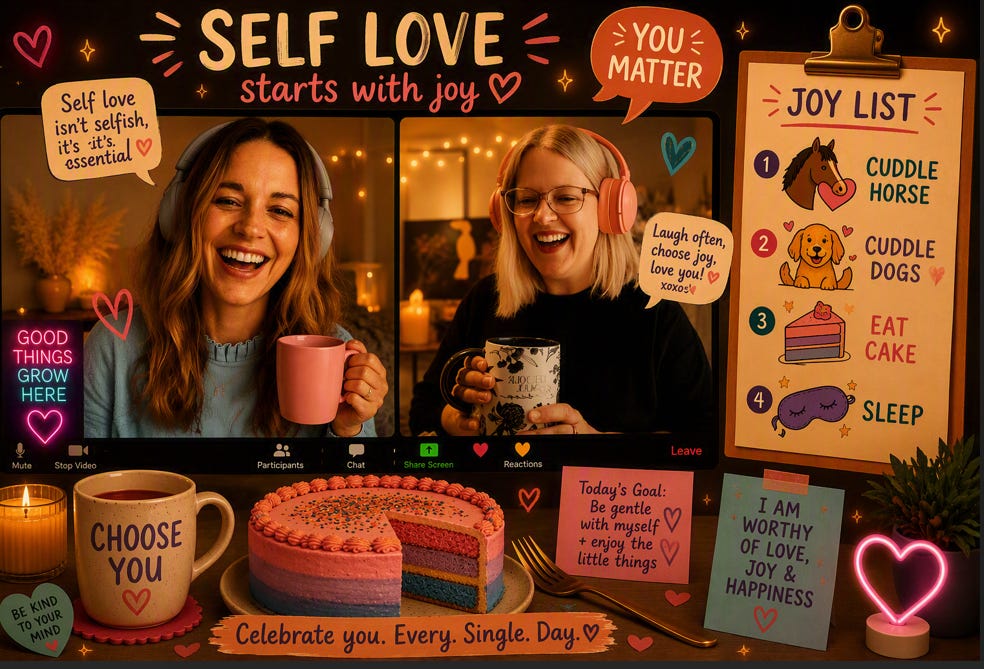
When we find self-love in a conversation, it is a feeling, a spark or an idea with another writer, sharing our real-life journey feels like ‘home’ that nourishes our souls. There is no transection, just mutual benefit in the conversation. We feel less alone and more connected. Creating space for these conversations with other writers from across the world, feels small and means so much to me because it widens our personal networks, widens our social circle, creates ‘home away from home’ where we can pour hot water into a pot of loose-leaf tea, link into a Zoom, have a cup of tea, eat cake and chat about life itself in a philosophical way. These conversations and spaces are building something long lasting, that strengthens ideas and experiences of writing, it breaks isolation and inspires new possibilities.
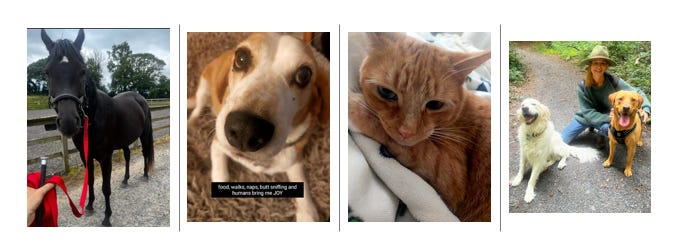
Our shared animal loves… meet our pets, who are also our emotional supporters and healers.

Katerina and Judith, the Zoom conversation seems to do several jobs at once: it interrupts isolation, gives unfinished ideas another mind to meet, and creates enough trust for future work to become imaginable. I especially value that we hear the relationship from both sides, since each of you can name something the other brought into the room that you could never have supplied for yourself. Independent writing may happen at a solitary keyboard, while a sustainable writing life can still depend on people who help the work remain alive between publications. Thank you both for letting us see the relationship becoming part of the creative process itself.