
Buzz Inquiry into Worldviews and Meaning Making
Exploring our mental models, interpretations of self, society and the world around us.

Sitting in a lecture theatre I blended into the crowd and listened insightful to Lived Experience lectures on mental health, in a quiet way it made me wonder about my own worldview and the worldview of others around me. I sat with the feeling of unease and tuning into my own feelings and learning experiences. My unease amplified from a place of lived experience of being an overseas born student where I often found myself with a different worldview.
I lived most of my life in ‘translation’ and it has always taken me longer to comprehend and interpret information in lectures, at work and in life. To help me understand how we learn, I wanted to unpack and explore the word “worldview” in a little more detail. I introduced the concept of worldviews in previous post BeeHive Worldview using a playful beehive metaphor. Now I want to share some quotes and thoughts from others on the topic of worldview.
I thought I would start with something that may be familiar, James Sire’s book Naming the elephant: Worldview as a concept is a source of where the word “worldview” is explored by a variety of philosophers and definitions of worldviews are shared, here are some examples:
“Every person carries in their head a mental model of the world – a subjective representation of external reality.” Alvin Toffler, Futurologist
“A set of mental categories arising from deeply lived experience which essentially determines how a person understand, feels and response to action to what he or she perceives of the surrounding world and the riddles it presents.” Wilhelm Dilthey, German Philosopher
“A worldview (or vision of life) is a framework or a set of fundamental beliefs through which we view the world and our calling and future in it. This vision need not be fully articulated: it may be so internalized that it goes largely unquestioned; it may not be explicitly developed into a systematic conception of life; it may not be theoretically deepened into a philosophy; it may not even be confined into creedal form; it may be greatly refined through cultural-historical development. Nevertheless, this vision is a channel for the ultimate beliefs which give direction and meaning to life. It is the integrative and interpretive framework which by which order and disorder are judged; it is the standard by which reality is managed and pursued; it is the set of hinges on which all our everyday thinking and doing turns.” James Olthuis, Theology philosopher, USA.
Worldviews are also being explored in professional settings too, Alison Gray formulated a definition to what a worldview maybe in her organisation and area of practice and she conceptualises it as:
“A worldview is a collection of attitudes, values, stories and expectations about the world around us, which inform our every thought and action. Worldview is expressed in ethics, religion, philosophy, scientific beliefs and so on.”
In a YouTube video by Circle of Life Susie Jones, Elder from Walpole Island First Nation, Canada formulates a response to What is the Aboriginal Worldview? - Aboriginal Peoples are advised to open this link with caution as it may contain images, voices and names of deceased people.
A short Australian ‘PlantDoc’ documentary shares the stories of Aboriginal Australians. The Men of the Fifth World Times – Aboriginal Peoples are advised to open this link with caution as it may contain images, voices and names of deceased people.
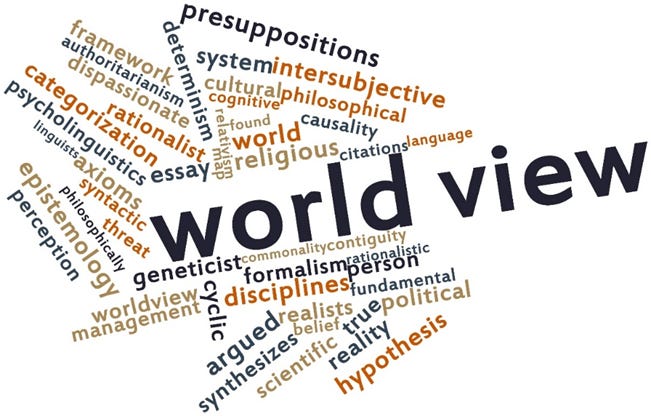
In my brief investigation of what a worldview is, I will attempt formulate a definition for myself; “a worldview is shaped by the early life experiences a person learns from their families, friends, communities, culture, religion, spirituality and society. It forms the individuals’ values and beliefs about the world”. The graphic below captures some other words that may describe worldviews.
My beehive metaphor took over as I tried to re-imagine what this would feel like in a colony of bees.
Appreciation of the social world and diverse worldviews provides us with rich learning opportunities to be part of a lifelong learning journey. At times, it may clash with our own worldviews or the worldviews of other bees or teaching queens, I attempt to translate how these can be incorporated into an inclusive interaction. My attempt to demystify the tensions that may exist between individuals as a result of misunderstanding or miss communication.
I would like to take this moment and focus on a sticky subject and explore Information Processing Theory (IPT). IPT views learning as the results of operations taking place in our brains.
In a bee‑hive way, information does not move in straight lines or rigid hierarchies it shimmers through the colony like sunlight catching on wings. Some bees gather data by zipping out to the edges, processing information of flower scent in full flight of the windy breeze. Others stay inside the hive, sorting, organising, and translating those discoveries into dances the whole community can understand. A few bees process slowly and deeply, turning nectar‑bits of insight into rich honeyed wisdom, in three ways, holding different capacity;
The sensory register few second capacity
Short-term memory approximate 30 second capacity
Long-term memory unlimited capacity.
The hive treats them as essential every style of processing, fast, slow, intuitive or analytical adds wisdom to the collective intelligence. The magic is not in uniformity; it is in the way each bee unique way of knowing strengthens the whole buzzing ecosystem.
Practicing compassion for self and others: A bee in learning may look and feel gentle with little quiet micro actions of self-love and compassion for others unconscious bias.
Connection, trust and gentle care is slow, intentional and learned over time through building a relationship and getting to know the other bees and the queen
Learning is specific to the subject with clear direction
Opportunities are provided for repetition and using the same concept/content in different ways without shame or judgement
Repetition is welcomed and nourished with conversation, illustration and clarifying questioning
Individual bees are encouraged to show courage and name what their needs are in communicating and learning with others
There is no silly question, bees are encouraged to question and analyse own interpretation and understanding too, it is important to develop these critical thinking lens in life, work and learning
Time and space in given when presenting information to allow opportunity to process it, retrieve it and apply it in their own creative way
Allow time for culturally, linguistically and neuro diverse bees, by affirming different information processing needs with care and compassion
Adapting environments to meet the sensory needs of all bees, working together as a team to ensure every bee feels comfortable and their sound, touch, smell, taste, sight senses are cared for.
On a closing journal note, I have the need to pause to feel the shape of my own worldview in a world full of wonder and curiosity where I embrace lifelong learning in a gentle, self-loving and compassionate way. Its tunnels, its honeyed biases, its familiar pathways are at every turn. I’m better able to wander into the combs of someone else’s life worlds. As my listening becomes softer, less guarded and more curious I open up to new ideas thoughts and wonderings. It turns into a moment of bee‑to‑bee recognition, where shared lived experience grows with its own wisdom and compassion that continues to grow with me.